
IP67 for connectors:
Why the protection rating alone is not enough
IP67 sounds like a high level of protection. A connector with this rating is protected against dust and temporary immersion.
For many industrial applications, that is an important requirement. Even so, a high IP rating does not automatically mean that a connector is suitable for every demanding environment.
For a connection that stays reliable over time, you always have to look at the application as a whole.
What does IP67 mean?
The IP rating describes how well an enclosure is protected against the ingress of solid objects and water.
With IP67, the two digits stand for different types of protection:
6: dust-tight, fully protected against the ingress of dust.
7: protected against temporary immersion under defined test conditions.
The protection rating is therefore important information when choosing a connector.
However, it does not answer every question that matters for the actual application.
Why IP67 alone is not enough
A connector can meet the required protection rating and still be unsuitable for a specific application.
The reason: in real-world use, several stresses often act at the same time.
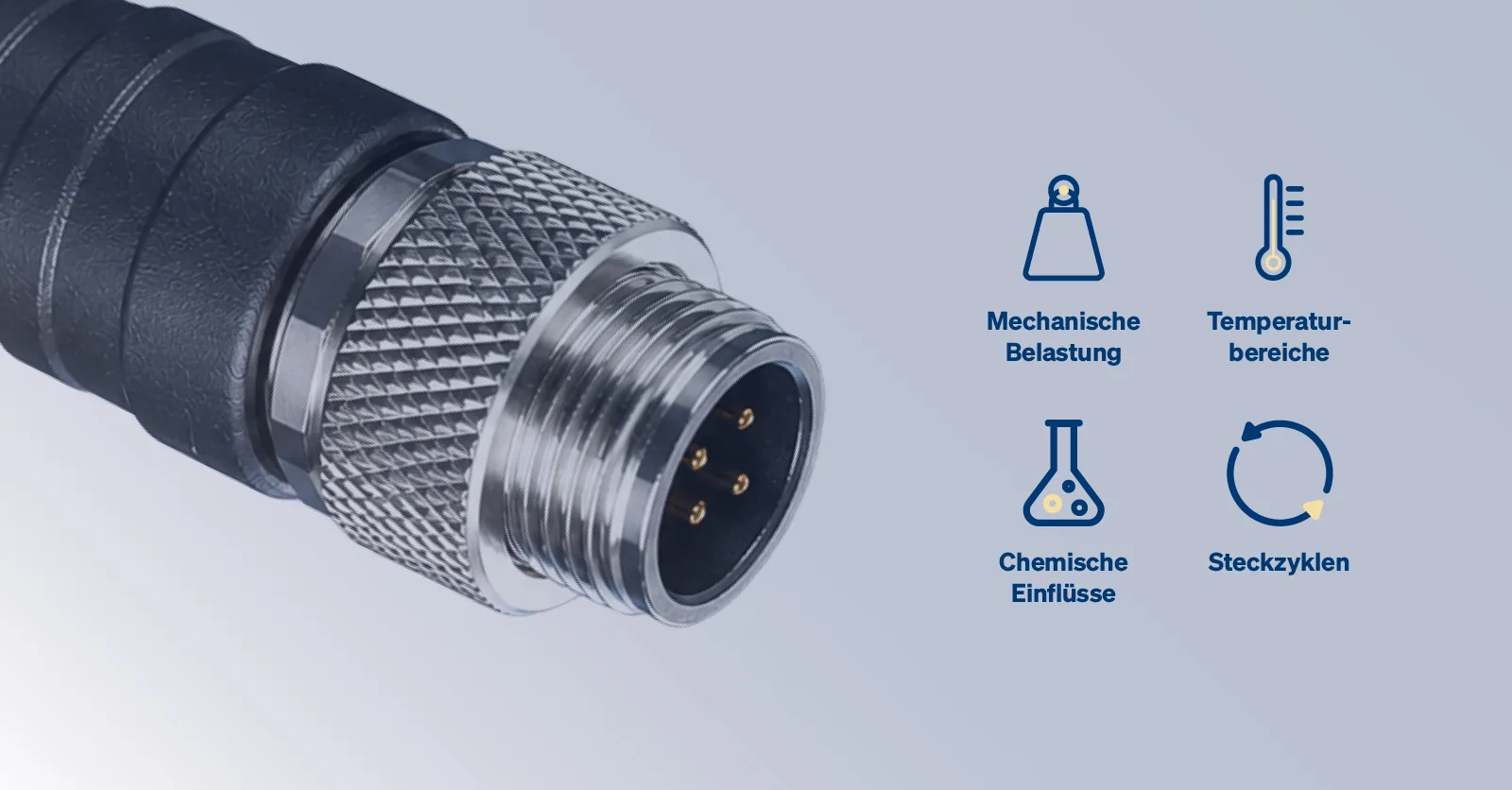
Temperature changes, vibration, chemicals or frequent mating and unmating can wear on a connection over the years.
That is why other factors should be considered alongside the IP rating.
1. Mechanical stress
Vibration and movement are part of everyday operation in many industrial applications.
Machines, motors or moving assemblies can put connectors under constant mechanical stress.
When choosing a connector, consider how much load the connection has to take and whether the locking mechanism, cable outlet and strain relief are suitable for these conditions.
2. Temperature ranges
Not every connector is designed for every temperature range.
Applications with very low or high temperatures and frequent temperature changes are particularly critical.
Over time, these conditions put stress on materials, seals and cables.
The permitted temperature ranges of the components used should therefore always be checked against the actual conditions of the application.
3. Chemical exposure
Oils, coolants, cleaning agents or other chemicals can affect plastics and seals.
A high IP rating says nothing about how resistant the materials are to specific substances.
In industrial environments in particular, it pays to take possible chemical exposure into account at the selection stage.
4. Mating cycles
How often is the connection mated and unmated?
A connection that is installed once and then left closed for years has different requirements from a connector that has to be disconnected regularly.
The specified number of mating cycles and the mechanical design should therefore match how the connector is actually used.
5. Consider the entire connection
The connector alone does not determine how reliably a connection is protected.
The cable, cable gland, seal, assembly and the specific installation situation all play a part.
A reliable connection is always the result of all components working together.
The protection rating matters – but it is only part of the solution
IP67 is an important selection criterion for connectors. However, the protection rating should not be considered in isolation.
A suitable connection also takes into account:
mechanical stress
temperature ranges
chemical exposure
mating cycles
installation situation
cable and cable outlet
Only the combination of these factors shows whether a connection suits the application in the long term.
Continue to our solutions page on waterproof connectors.
Which connector is right for your application?
Engelking helps you choose connectors for a wide range of industrial requirements. We don't just look at individual technical data, but at the conditions of the entire application.
Get in touch – together we will find the right solution.